

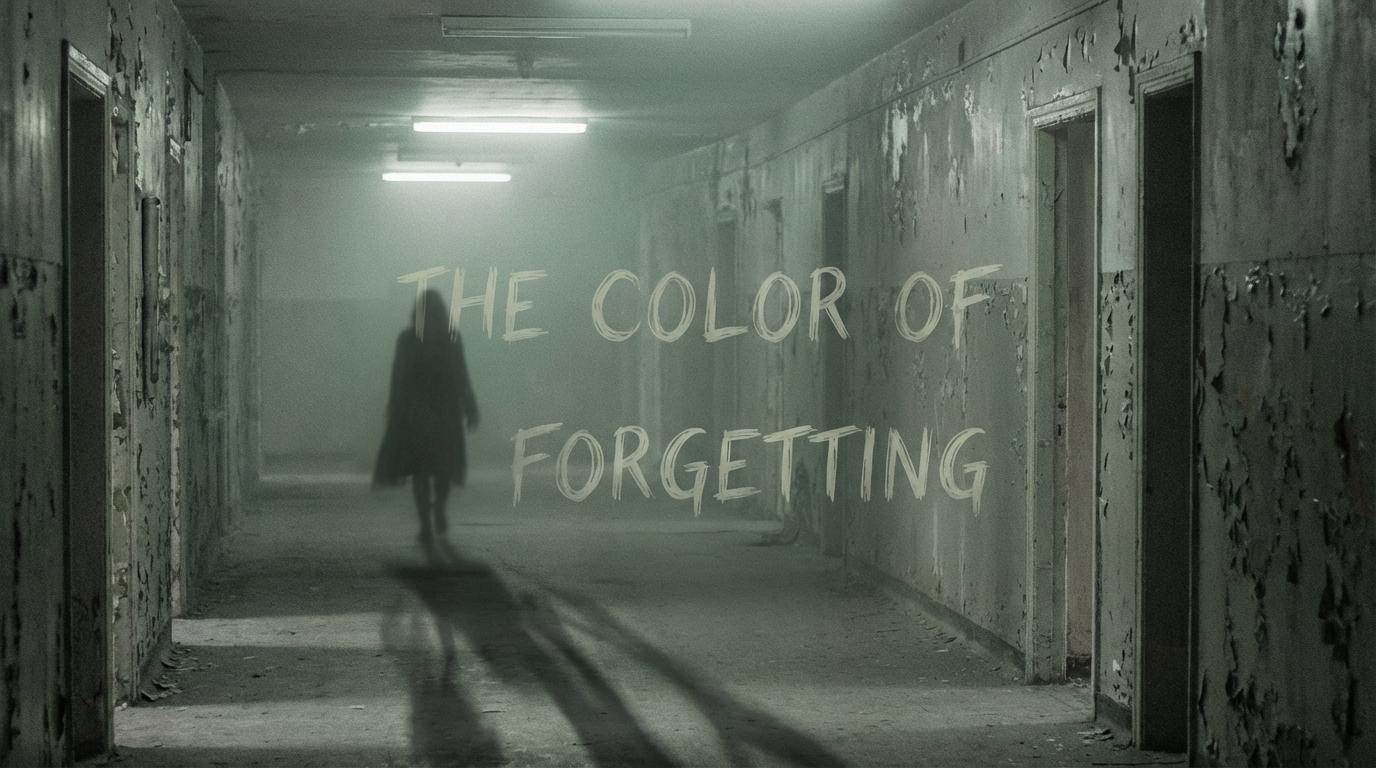
By Ric Perrott
The breeze on my face is the first thing I recall—cool, sterile, and carrying the scent of something I can’t quite place. Antiseptic? Or the moment right before the rain starts to fall. My eyes are closed, though I have no memory of doing so.
I cannot remember how I got here. Thoughts slip through my fingers like water.
My eyes open, and I’m sitting in a chair. The room around me is beige. The walls, the floor tiles, even the light—aggressively, oppressively khaki—as if I can no longer visualize what color is. There are chairs arranged in neat rows, the kind you’d find in a doctor’s office or a DMV. Functional. Forgettable. But there’s no reception desk, no magazines, no people.
Just me.
I stand, and my legs work fine, which surprises me for reasons I can’t articulate. A riptide of cold slides across my back, and I turn. The chair I’ve left behind is empty, but my shadow still lingers there. A dark remnant of myself remains seated, and for a moment, I am both standing and sitting, here and there. Then, like paint peeling from a wall, my shadow curls up and slides off of the chair, merging silently back into me.
The room is larger than it first appeared—or is it smaller? The walls shift, like they’re only there when I look at them. Everything is slightly out of focus, as if I’m looking through my father’s prescription glasses. Once, when I was eight, I’d put them on; the world going soft and wrong. He’d laughed and said that I looked like a tiny professor. “Can you see?” he’d asked. I’d said no, that everything was blurry, but I kept them on anyway because it made him smile.
There are three doors in the room. One to my left, one to my right, one straight ahead. All identical. All closed.
I didn’t come through any of them.
The breeze floats across me again, stronger this time, but there are no windows, no vents, nowhere for air to enter. Yet it’s full against my skin, raising goosebumps on my arms. My footsteps make no sound on the vinyl tiles as I head to the door on the left. I reach for the handle, and as my fingers are about to touch it, something moves in my peripheral vision.
I spin around.
Nothing. Except the chairs are all askew now. Each one slightly off.
I saw something. Didn’t I? A shadow? Or a person. Someone tall, with broad shoulders. The image is already fading. A dream in the first moments after waking, but the shape of it remains—achingly familiar.
“Who’s there?” My voice is flat, absorbed by the tan walls before it can echo.
No answer. Of course there’s no answer.
The door is locked—or maybe it just won’t open. I push against it, and it’s as if something on the other side resists with equal force. The door in the center is the same. My push, the resistance, the refusal.
The door on the right opens straightaway.
Beyond it is a hallway, long and narrow, lit by fluorescent lights that buzz with a sound just at the edge of hearing. The walls here are the same color, but there are darker patches where pictures might have hung once. Or perhaps they’re hanging now, but I can’t make them out. I step in, and behind me the door clicks shut. I turn. No handle on this side, just a smooth wall.
Forward, then. Always forward. Dad’s voice. His favorite saying.
The air is different here—stale coffee and floor wax and something else.
Old Spice.
I’m seven years old, face pressed against Dad’s shoulder, breathing him in while he carries me to bed after I fell asleep on the couch.
“I’ve got you, it’s okay,” he’d whisper.
The hallway stretches with each step, or I’m moving slower than I think. The door to my left opens onto a small room with a single chair facing the wall. There’s a coffee mug on the floor beside it, half-full, the liquid inside thick and scummy, white ceramic with a chip on the handle. Dad’s mug. The one he used every morning, filled with coffee so black and strong the smell reached my room.
On Sunday mornings, he’d sit at the dining room table with that mug and the newspaper, and I’d climb into his lap even though I was getting too big for it. He never said so; he’d just shift the paper so we could both read the comics, his chin resting on top of my head. “Which one first?” he’d ask as if it were the most important decision in the world.
The door clicks shut, my throat tightening. Keep moving.
The hallway opens into a larger space—a hospital cafeteria. The tables are empty, the food warmers cold and dark. But there’s a single tray left on one chair. A sandwich wrapped in plastic, untouched. An apple, and a small carton of chocolate milk.
Dad hated hospital food, but he always asked for the chocolate milk so I could drink it. “Some things never change,” he’d say, that slight smile playing at his lips even through the pain. I’d sit with him during visiting hours and make up stories about my day, inventing funny things that hadn’t actually happened because the real things—coming home to a lonely house, eating cereal for dinner while Mom cried in the bathroom—weren’t the ones he needed to hear. Plus, I loved his laugh and his sense of humor, like when he joked that he’d waited until summer to get sick so I wouldn’t have to miss any school. I managed a laugh, but it was just a sound to cover the sob caught in my throat.
The thought breaks apart unfinished.
There’s a window here. Finally, a window.
Rushing to it, I press my hands against the glass. Outside it’s foggy, thick and gray, obscuring everything. No ground, no sky, just fog. It swirls and eddies, and for a moment, a figure stands in it. Tall. Still. One hand raised in a wave, or a beckoning, or a goodbye.
Movement to my right. Definitely movement this time.
I whirl around to catch it: a figure disappearing through the cafeteria doors. Dark sweater, the particular slope of shoulders I’d know anywhere—and then they’re gone.
“Wait!” I shout, and this time my voice has somewhere to go, bouncing off the hard surfaces. “Dad!”
The word tears out of me, and I’m running, pushing through the double doors, but the hallway beyond is empty. This corridor is different—lined with windows set into doors at head height, small squares of reinforced glass. I peer through the first one, breath coming fast.
The bed is made with crisp corners, machines standing as silent sentinels. The angle of the window, the color of the walls, the way the afternoon light slants through the blinds. Room 447. For twenty-six days I sat while that light moved across those walls.
Behind me, somewhere distant, a voice. Deep and warm, speaking words I can barely make out, the cadence is so familiar my eyes burn.
“Hey, kiddo.”
That’s what he always said. “Hey, kiddo.” When he’d come home from work. When I’d visit the hospital and find him awake, those increasingly rare moments of clarity between the fog of medication and the deeper fog of whatever was taking him away from me piece by piece.
The last time he said it, really said it, I’d been reading to him. His favorite book, because I didn’t know what else to do with the silence. He’d opened his eyes, focused on my face, and smiled. “Hey, kiddo,” his voice rough and small. “You don’t have to stay, you know. I’m okay.”
But he wasn’t okay. We both knew he wasn’t okay.
“I want to stay,” I told him.
He closed his eyes. When he opened them later, he didn’t know who I was. He’d never know again.
I turn away, vision blurring. The hallway is empty, but that presence, that warmth lingers, like standing in a room someone’s just left, the air still shaped by them.
“Dad?” I call again, quieter this time. “Are you here?”
The buzzing of the fluorescent lights is my only answer.
There’s a stairwell at the end of the corridor, and I take it, though I can’t tell if I’m going up or down. The sensation is wrong, like I’m walking sideways. The stairs empty into a curved room with windows on one side. In the stairwell’s strip light, my shadow hesitates three steps below me, as if urging a different direction before sliding to catch up.
Photographs line the inner wall of the space—black and white, but reversed like a negative. There’s one of him alone, thinner than I remember. When was this taken? His smile is hollow, almost as if he’d forgotten how to.
Another, in a hospital gown. He’s making a joke of it, giving a thumbs up to the camera, but the reality wasn’t a joke. The cold truth of the photographs clashes with my warm memories.
One more: me and him together, but I’m doing all the supporting now. My arm around his waist, his weight against me, he’s giving me ‘rabbit ears’ even though he can barely walk. I don’t believe I could ever be that strong.
When the final day arrived, Mom slipped an inside-out sweatshirt over my head and tossed me in the car. Driving faster than I’d ever seen her, hands trembling on the wheel. Parking in a handicapped spot and running into the hospital over my protests. Almost slipping in the corridor as we turned the corner into his room and—
The memory scatters like startled birds.
The lights flicker. Once. Twice. In the moment of darkness between, he is there. Clear. Standing at the far end of the room, backlit by light that shouldn’t exist. He’s not looking at me. He’s looking at something beyond, past me. His posture is relaxed, peaceful. A man who’s finished a long journey and is looking forward to the nothingness.
The lights steady.
He’s gone.
But his scent remains. And the ghost of a hand on my shoulder, gentle and reassuring. The way he used to wake me for school—that firm touch and quiet voice pulling me out of my dreams.
“Time to get up, kiddo.”
I walk to where he was standing, and the room curves back on itself, impossibly, geometrically wrong. A familiar door stands before me. I’m back at the beginning, or an ending, or a point that is neither.
Behind me, a voice, so close it could be a whisper in my ear.
“It’s okay. Don’t be scared.”
Those are the same words he said in the hospital. The same words he said when I was small and afraid of the dark. The same words that have followed me through every fear, every uncertainty, every moment of standing at a threshold and not knowing what waits on the other side. The same words that led me here.
The door handle is cold, the way Dad’s hand felt in mine on the last day. His skin paper-thin, veins visible like a map of rivers. He couldn’t speak anymore, but he’d squeeze my fingers sometimes, and I’d squeeze back, our own language of presence and love and the unbearable fact of letting go.
I push the door open, and the floor gives way underneath me, that sickening free-fall sensation, but I’m not scared. I give in, exhausted by a weariness that goes deeper than my body, into some core part of me that wants, desperately, to stop wandering.
Light floods my vision.
White and bright and engulfing.
It comes from nowhere, from everywhere, swallowing the room and the locked doors and the impossible corridors. I’m falling or flying or simply being, and there’s no sound, just light, the fading smell of Old Spice and the phantom pressure of a hand in mine.
My eyes open, and I’m sitting in a chair. The room around me is beige.
I remember how I got here. The world had gone out of focus, and I’d grown tired of squinting, so I’d simply chosen to stop trying to see. Easy. Painless.
The center door stands slightly ajar. Not fully open, just enough to suggest possibility. A warm luminescence spills through the gap, golden and tender, the way a late afternoon sun filters through autumn skies.
And standing beside it, one hand on the frame, is Dad.
He looks the way I remember him best—not the hollow man in the hospital bed, not the thin ghost of those final photographs, but him. Solid. Real. The blue cardigan I gave him for his birthday three years before he got sick. His salt-and-pepper hair. His face relaxed and content, free of pain.
He sees me and smiles. He knows who I am.
He doesn’t speak. He doesn’t need to.
His hand extends to me, palm up, the same gesture he’d made a thousand times. When I was learning to walk. When I fell off of my bike. When I was scared after a nightmare.
An invitation. An offering.
I stand. My legs are shaking, or that’s just my perception. It’s possible I’m perfectly still.
Dad’s hand remains outstretched. Patient. Waiting.
The light behind him is so bright that it obscures whatever lies beyond the door. It could be anything. Nothing. Everything.
I step forward.
Close enough now to smell the aftershave. Close enough to notice the laugh lines around his eyes, the familiar way his cardigan sits on his shoulders. Close enough to take his hand. I do.
“Dad,” I whisper, and my voice breaks on the word, cracks open on everything it contains—grief and love and longing and the terrible, beautiful relief of seeing him whole again, even here, even now, in this impossible place.
The choice is mine—follow or stay, step through or let go, walk into the light or remain in the color of forgetting.
His hand is so warm, and I miss him so much. Would it be selfish? Would I be missed?
A paralysis holds me in place, caught within the weight of this decision. Is this real or a dream, or something else entirely? Something that exists in the space between waking and sleeping, between living and—
I glance at the chair, and my shadow is there, arms crossed. Like I was at nine years old, digging in my heels outside of the dentist’s office.
The breeze touches my face again.
The door opens.
Light or shadow.
The Color Of Forgetting ©2025 Ric Perrott. All Rights Reserved