

Posted on May 30th, 2026
I had nothing for him to sign.
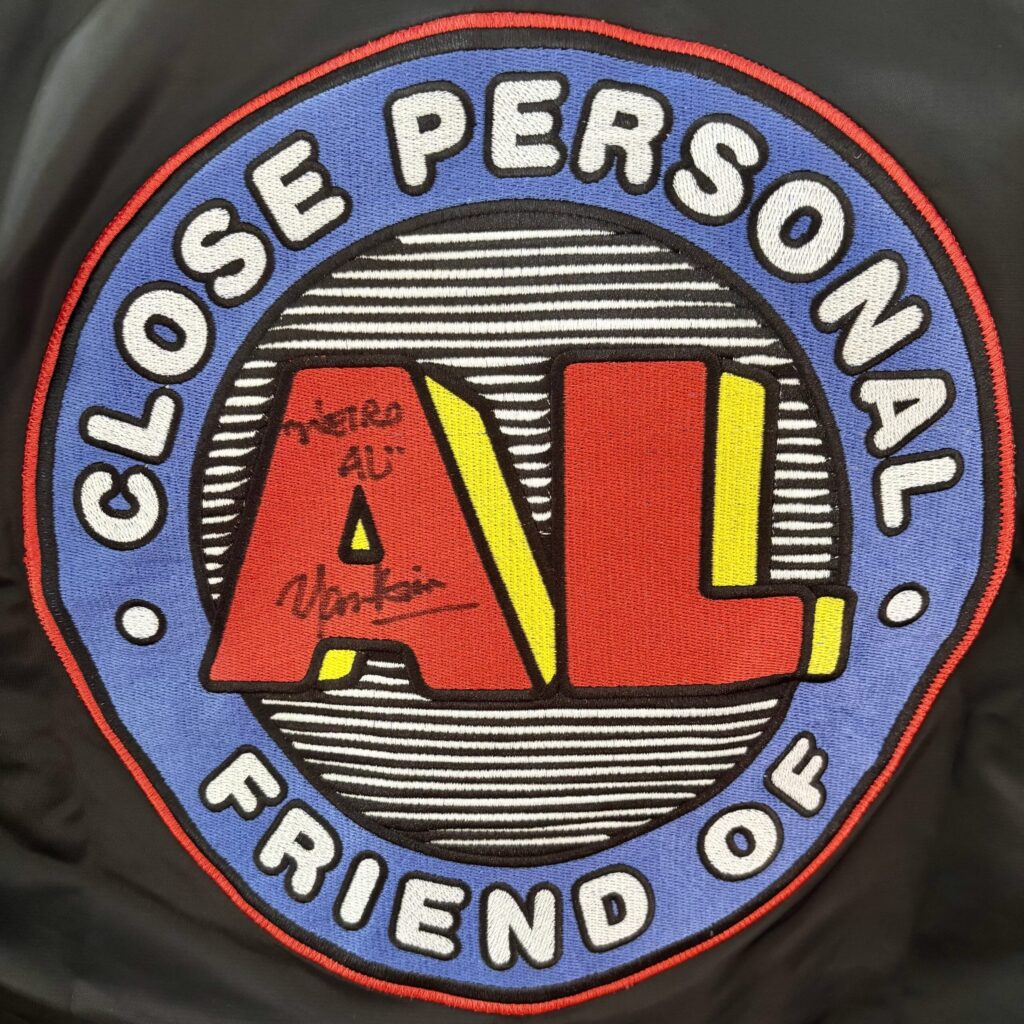
Months of planning—I’d had the ticket since March—and somehow that one practical detail never crossed my mind. What saved me was the windbreaker they’d handed each of the “VIPs” on the way in, black, embroidered across the back with the words Close Personal Friend of Al. I decided that’s what I’d have him sign. Seemed fitting.
The line inched forward, and the giddy couple ahead of me slipped through the gap in the curtain, while the two guys behind me—strangers an hour ago, now sworn allies after a long and far too serious conversation about the golden age of professional wrestling—started digging out the things they’d brought. My turn was next. The better part of forty years of fandom, months of buildup, and it all came down to a few feet of carpet and a strip of blue tape on the floor.
A bright-eyed assistant waved me in. I stepped behind the marks, the enormous tour backdrop looming behind me, and looked to my left.
There he was.
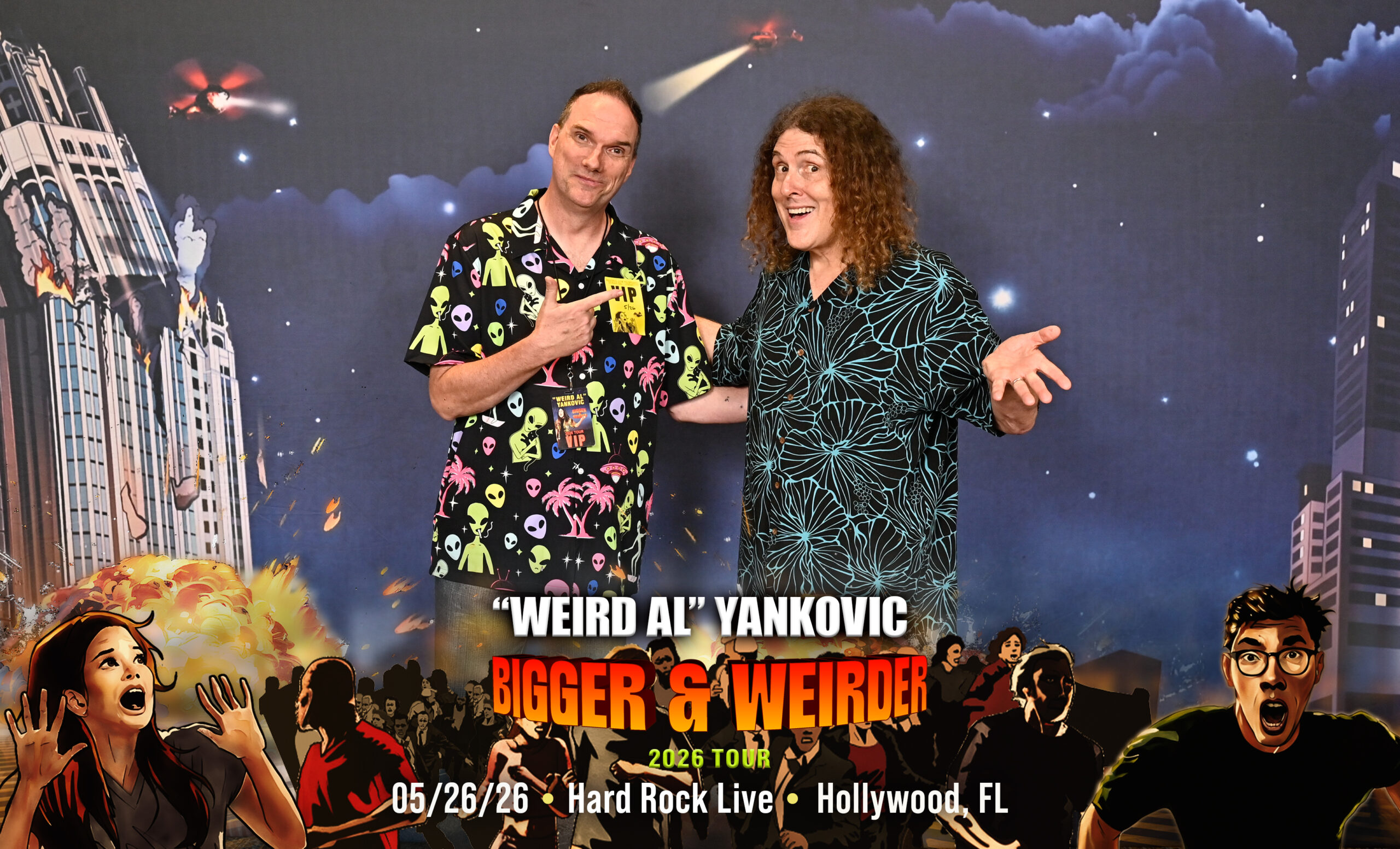
“Weird Al” Yankovic, not two feet away, smiling like he’d been waiting all night to meet me. I stepped in, he draped an arm across my back, and I arranged my face into a shape I hoped read as composed adult, even as the rest of me threatened to come apart. The flash went off, and I prayed I’d kept my eyes open.
As we walked to the side table, Al gestured at my shirt—a Hawaiian number covered in big-eyed aliens surfing, petting cats, and smoking questionable cigarettes; something I’d picked out months earlier for precisely this moment. He noticed. He said, “That’s a great shirt,” and I came closer to passing out than I’m willing to admit.
Here’s what you have to understand about a grown man going weak in the knees because Al liked his shirt: the compliment didn’t land on me. It landed on a twelve-year-old in his bedroom on Long Island.
Back then, my Sunday nights ran on a secret schedule. Long after I was supposed to be asleep, I’d pull the covers over my head, press a pair of cheap orange foam headphones to my ears, and tune the knockoff Walkman I’d gotten for my birthday to WRCN, where the Dr. Demento show came on at eleven. Most of what crackled through was novelty-song flotsam—and I loved all of it—but inevitably the airwaves delivered the very thing I’d been lying awake for, a “Weird Al” song, and I’d shake under the blankets, mouthing the lyrics and trying to laugh without making a sound, which, if you’ve ever attempted it, you know is its own particular kind of agony. Being a zombie in math class the next morning was a price I paid gladly.
In 1983, I took my paper route money—actual, hard-earned quarters with the occasional tattered dollar bill—to Record World and bought the cassette of his first album. Everyone knew “My Bologna” and “Another One Rides the Bus,” but it was the gleeful idiocy of “Gotta Boogie” that spoke directly to my thirteen-year-old soul, and “Stop Draggin’ My Car Around” fed right into the Tom Petty obsession I’d been nursing. I played that tape into the ground.
I’ve tried for years to explain why it was Al, specifically, and not someone “cooler” that made such an impression on me. It wasn’t only that he was funny. It was that underneath the funny sat a real musician—accordion and all—who clearly knew what he was doing. That first record was admittedly sparse, but when In 3-D arrived the next year, the truth got loud: this wasn’t just a guy cracking jokes over borrowed tunes. This was a serious craftsman who had chosen to be ridiculous. And to a kid who was a budding musician, a secret scribbler, and a card-carrying suburban nerd, that was a revelation. He made the things I was quietly embarrassed about look like they might one day add up to something.
I didn’t have the words for it then. I just knew I’d found my guy. And that’s how it began—this relationship that would run over forty years in exactly one direction.
By the time we reached the signing table, I was carrying four decades of thoughts and memories, and I needed to find the perfect slice to carve out and serve up to him.
That’s the part nobody warns you about. You spend a lifetime building this person up in your head, and then you get a minute and a half with them in the flesh, and your brain seizes trying to decide what to actually say out loud.
I led with the show because it was safe ground. I told him the setlist had been inspired, and that the full-band cover of George Harrison’s “What Is Life” was a highlight of the night. He thanked me, and I think he meant it—the song wasn’t one of his, nor an obvious crowd-pleaser, but it was the kind of track one musician appreciates in another’s set—and for a few easy seconds it felt like we were just two guys talking music.
Then I said the thing I’d been rehearsing for weeks, the line I’d decided mattered most. I told him I hoped it wouldn’t make him feel old, but I’d been a fan since I was twelve, listening to the Dr. Demento show and waiting for his next masterpiece to play. He laughed. “I’ll take it,” he said.
And here’s the strange part. I had just made “Weird Al” laugh—a literal childhood dream, checked off in real time—and even as it happened, I could feel myself watching. Standing a half-step outside the moment, already filing it away instead of simply living inside it.
He signed the back of the windbreaker, right on the enormous A in Close Personal Friend of Al. I watched the Sharpie move and thought, absurdly, that’s his actual hand, making his actual signature, on a thing I get to keep. We shook hands, and I wished him luck on the tour. He thanked me, already half-turning toward the next person in line, when a gentle hand landed on my shoulder and guided me toward the exit.
And just like that, it was over. I stepped back into the hallway, jacket in hand, past the endless line of people still waiting for their own ninety seconds—and I felt something I hadn’t expected. It took the fresh air outside the venue before I could put a name to it.
It wasn’t disappointment—he’d been everything I’d hoped and more, gracious and kind and honestly friendly. It was the asymmetry of it all. Those ninety seconds were going to live with me for the rest of my life, replayed and retold at dinner tables for years. Yet Al would have almost certainly forgotten me before the ink on the jacket was even dry.
For a second, that stung. Then I thought about it, and the sting turned into something closer to awe. Of course he wouldn’t remember me. He’d just played a two-hour show—filled with costume changes, at a physical pace that would fold men half his age—and then stood at a table and handed that same warmth to person after person after person, a line of us running down the hall, each one certain that our moment was the moment. He couldn’t possibly hold all of us—we were just a blur to him. Yet he treated each of us as if we were the VIP our pass proclaimed us to be. A man with every excuse to coast, choosing not to, ninety seconds at a time. That’s certainly something. Hell, that might be the whole thing.
And that’s when I realized it. The blur isn’t a flaw in him. It’s the proof. The very thing that made my ninety seconds feel small from his side—that I was one of thousands—is the exact measure of everything I admired about him in the first place. The instant of sadness could never cancel the gratitude. They were the same feeling wearing different Hawaiian shirts.
When I reached my car, it struck me that in my own way I could be inching toward the other side of this myself. Not at his scale, clearly, but when something I’ve written lands with a stranger, they walk off carrying a piece of me, and I might never know their face. I’m only beginning to learn what that costs, and what it’s worth.
So here’s where I come down on the old adage about meeting your heroes.
I think it aims at the wrong target. The risk was never that Al would let me down—he didn’t, not for a moment. The risk is in expecting ninety seconds to carry the weight of a lifetime. Nothing could. The fantasy was mine; I’d spent decades building it, and he walked up having spent none. That’s not a tragedy. That’s just math. The handshake would never be the payoff—it was simply a thank-you for all the years of joy, and for helping this white & nerdy kid feel seen.
When I got home, I hung the jacket on the back of my office door, where I could see it while I write. Close Personal Friend of Al. They handed that same jacket to everyone in line, Al’s little joke about the manufactured intimacy of a meet-and-greet. But the lopsided truth is that he has been exactly that to me: a close personal friend for decades who never knew I was out there. The jacket doesn’t have the relationship wrong. It just leaves out that it only ever ran one way.
Maybe that’s what every artist is to the people they reach—a close personal friend who doesn’t know your name. I’m grateful for all of it—the music, the compliment, and the forty years in between. Forty years that only ever flowed in one direction—until, for ninety seconds, they didn’t, and I got to stand beside him and say thank you. Even if he’s forgotten it by now, I never will.